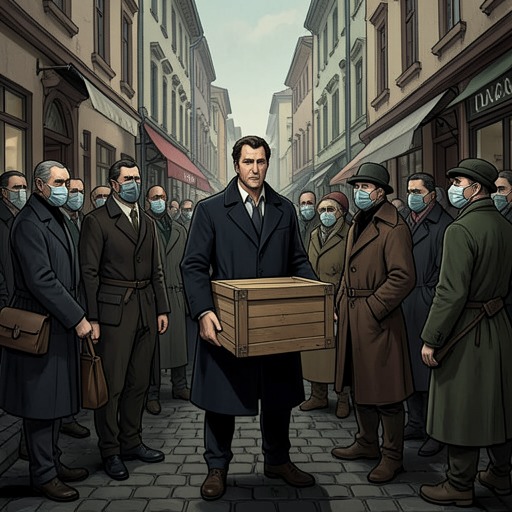
Vincenzo confronts the crowd outside the aromateria
The Florios of SicilyVincenzo confronts the crowd outside the aromateria during Palermo’s 1837 cholera epidemic, when interrupted shipping leaves the shop without essential medicines and a terrified crowd threatens to break in. He keeps the crowd from destroying the shop not by producing supplies he does not have, but by making the shortage visible and staking his credibility on what the people already know of him. The episode tests the Florio business at the point where commerce meets public need: its doors signify both a livelihood and a hoped-for refuge, but during the epidemic even the largest trader in Palermo has nothing to sell.
Causes and Setting
The encounter unfolds during an epidemic that reached Sicily in June 1837 and was not eradicated until early October. Poor hygiene helped the disease spread, and contemporary accounts cited in the narrative report 23,000 deaths in Palermo alone. Fear extends beyond illness itself: Vincenzo hears of a pharmacy ransacked in the Tribunali district and of priests murdered in the countryside because they are suspected of spreading infection. In this atmosphere, an empty medicine shop is not merely a failed transaction. It is a visible sign that ordinary means of care have broken down.
The Florios’ business depends on a trade network that reaches far beyond Palermo. Spices and medicinal goods pass through many hands, travel overland and across the sea, and become more expensive with each stage. At the start of the nineteenth century, British and French merchants supply European ports with colonial goods, while Palermo’s aromatari have organized themselves into a guild. The Florios have advanced within this changing market, but their own supply still depends on shipping and customs. They store goods in rented rooms at Palazzo Steri, paying import duty only when merchandise actually enters Palermo; stock moving onward to other ports can remain in storage without incurring the same tax. During the epidemic, however, this commercial arrangement cannot overcome the city’s restrictions or replace the ships that are no longer arriving.
The Shortage Becomes a Confrontation
Before reaching the aromateria, Vincenzo learns from Francesco Di Giorgio, who oversees trade with the Sicilian provinces, that supplies have disappeared. Valerian tincture, pepper, cardamom, and mint essential oil are gone; the little remaining stock has been requisitioned. Vincenzo runs to the shop, where manager Carmelo Caratozzolo stands outside the door trying to tell the people that there is nothing left. A man pleads for laudanum to ease his wife’s pain; a young father asks for valerian for his daughter. Others curse, beg, and press toward the entrance.
Vincenzo has to force his way through the crowd with his elbows. The terror on people’s faces overwhelms him, registering as a physical burden rather than an abstract problem of supply. When an old man throws a stone at the window and accuses the Florios of hoarding spices for their friends, Vincenzo sees the danger plainly: the crowd may destroy the aromateria. The shop is not incidental to his life. He first entered it at eleven, when his uncle showed him the sign of the injured lion, and he has in a sense never left. In the crisis, he wishes his uncle were beside him, but must step forward himself.
He puts himself between the crowd and Caratozzolo and shouts for everyone to stop. The people fall quiet, watching him with both hatred and hope. Their demand is not only for medicine: a young man falls at Vincenzo’s feet and asks him, at least, to help. Caratozzolo insists that the shelves are truly empty; tears in his eyes, he wishes he could help those pleading with him. His distress reinforces the fact that the shortage is not a pretext devised by the shopkeeper.
Trust, Proof, and Dispersal
Vincenzo answers the accusation of hoarding by naming the people around him and recalling their family circumstances. He recognizes Vito as a fish-market worker whose father, Biagio, is a ship’s carpenter, and knows that Vito has a little girl the same age as his own daughter. He recognizes Bettina as the wife of Giovanni, a marble polisher, and knows Pietro as a stonecutter. The gesture gives his appeal a particular basis: he is not addressing an anonymous mass but neighbors whose lives he knows because he lives among them.
Still, some in the crowd call him a liar and accuse him of saving the spices. Vincenzo points to the absence of carriages and soldiers, explains that the supplies at Palazzo Steri are exhausted, and says that nothing can get through until health restrictions are lifted. When Bettina cannot understand how Palermo’s largest trader can have nothing left, he offers the decisive test: anyone who doubts him can go inside and see for themselves. The crowd hesitates, then opens up amid cries and sobs and gradually disperses. The invitation to inspect the empty premises succeeds where argument alone might not: the claim is made verifiable, and the threat of violence recedes.
Only Vito remains on the ground. Vincenzo bends over him, puts a hand on the back of his neck, and tells him to go home and pray, because only God can help Palermo. The instruction offers no medicine and promises no remedy. Vito bursts into tears, and the sound stays with Vincenzo because he now hears a father’s weeping differently. He imagines himself in the same posture, desperate for medicine for Angelina, Giuseppina, or, most frighteningly, Giulia. The encounter ends with the crowd dispersed, but not with the need that brought it there answered.
Aftermath and Significance
The next day, Vincenzo reaches the house in Monreale where Giulia and the girls are staying. He remains silent and ill-tempered, carrying the memory of Vito’s tears. At night he visits his sleeping daughters and listens to their breathing, relieved that they are alive and well. The movement from the crowd to the family gives the confrontation its private consequence: the pleading for a sick child is no longer distant from Vincenzo’s own paternal fears.
The episode also places the Florios’ commercial ascent against the limits exposed by crisis. The business has grown through long-distance supply, careful warehousing, and the circulation of goods, but dependence on ships and open routes leaves it vulnerable when epidemic restrictions halt trade. A woman had earlier come to the shop unable to afford an apothecary’s prices and asked the brothers to sell her husband’s prescribed herbs; in the cholera emergency, the same basic question of access returns on a much larger and more dangerous scale. The aromateria can serve people only while it has stock. Here, Vincenzo’s authority rests not on the power to provide what has vanished, but on his willingness to stand before those who need it, tell them the truth as he sees it, and let them judge for themselves.
His conduct is therefore both an act of protection and an admission of helplessness. He saves the shop from the crowd, yet cannot restore its supplies or relieve the suffering of those gathered outside. The empty shelves expose the distance between commercial prominence and practical power in a public emergency. What remains available to him is a local form of trust—built from recognition, shared residence, and personal accountability—and even that cannot make the medicines return.